google ads

Wednesday

Paintings by Martina Yeon, Korean Artist

Paintings by Martina Yeon Korean ArtistStill Life with Roses


Martina Yeon was born in South Koria in 1962 and began to draw from a young age. She studied painting at the Korean University in 1978 and then went on to obtain her qualification as a Fine Arts Teacher. Martina has experience in a wide range of subjects and techniques, moving to Spain in 1991 where she dedicated herself to painting, learning from the Spanish masters such as Goya and Velazquez. Martina works in a new contemporary realism of still lifes and flowers.

Painting by Martina Yeon Korean ArtistStill Life


Still Life by Martina Yeon Korean ArtistStill Life with Roses

Tuesday

Ramon Pujol Spanish Artist

Artwork by Ramon Pujol Spanish ArtistPark in Portofino

Artwork by Ramon Pujol Spanish ArtistCapri


Artwork by Ramon Pujol Spanish Artist>Churs

Artwork by Ramon Pujol Spanish Artist>San Giorgio, Portofino

Paintings by Ramon Pujol Spanish Artist>Shops At La Piazzetta

Paintings by Ramon Pujol Spanish Artist>Reflections of Portofino

Monday

Carl Spitzweg (1808 - 1885) German Painter of Biedermeier era

The Widow


Carl Spitzweg, a German romanticist painter, came from well to do middle class circumstances and originally worked as a pharmacist. He is considered as one of the most important representatives of the Biedermeier era.
Thanks to his established position in society and an inheritance, he could follow his real calling and dedicate himself entirely to painting. Spitzweg was a self-taught artist, however he insisted on acknowledgement as a professional artist. In 1868 the painter was named honorary member of the Munich Art Academy. Spitzweg sold around 400 paintings during his lifetime.
For the most part Spitzweg's small-format genre paintings show untroubled small town life or country idylls with an ironic, yet kind-hearted accent.

Newspaper Reader in a Garden


The Letter Messenger in Rosenthal

Saturday

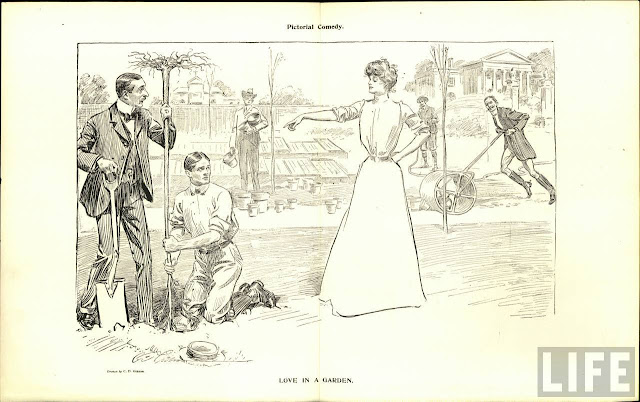
Charles Dana Gibson (1867-1944) and the Gibson Girl

Charles Gibson. American Illustrator. The Gibson Girl. Illustration

In her book America's Great Illustrators, Susan E. Meyer described the Gibson Girl the best way:

"She was taller than the other women currently seen in the pages of magazines.. infinitely more spirited and independent, yet altogether feminine. She appeared in a stiff shirtwaist, her soft hair piled into a chignon, topped by a big plumed hat. Her flowing skirt was hiked up in back with just a hint of a bustle. She was poised and patrician. Though always well bred, there often lurked a flash of mischief in her eyes."


Charles Gibson. American Illustrator. The Gibson Girl


Charles Gibson was born into a wealthy New England family. Recognizing his artistic talent his parents enrolled him in the Art Students League. At the age of 18 Charles started his career with a new magazine then Life.

Gibson'd audience enjoyed the manner in which he poked fun at high society characters. His monthly salary started at $33, the third month he was paid already $185. Tid-Bits, which was later re-named Time magazine, also bought his illustrations. Later Gibson waorked also for Scribner’s Magazine, Century, and Harper’s Magazine.
He started drawing ‘The Gibson Girl’ in 1890. His wife, Irene Langhorne Gibson, was the model for ‘The Gibson Girl’- she was an ideal image of youthful American femininity, the modern woman, athletic, smart, stylish, and desirable and she sold magazines.
Condé Nast agreed to a sharing relationship with Life, for a contract for $100,000 for 100 illustrations over a four-year period. At the height of his career, his salary had reached $75,000 per year.
By 1920 Gibson had the controlling shares of Life magazine, although he sold it in 1932. Gibson suffered a heart attack on his island off the coast of Maine, by the request of president Franklin D. Roosevelt, Gibson was flown via Navy seaplane to New York, where he died a few weeks later.


Charles Gibson. American Illustrator. The Gibson Girl
Charles Gibson. American Illustrator
Charles Gibson. American Illustrator. The Gibson Girl

Friday

Paul Klee (1879–1940): "I cannot be understood at all on this earth."


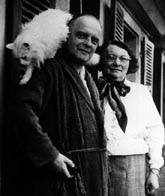
Paul and Lily Klee, Bern, 1935Paul and Lily Klee, Bern, 1935
Paul Klee was born in Münchenbuchsee near Bern. His father, Hans Klee and his mother Ida Maria Frick were musicians; and Klee himself was a talented violinist.
Klee studied drawing and painting in Munich for three years (1898–1901). In 1911 he became involved with the German Expressionist group Der Blaue Reiter (The Blue Rider), founded by Wassily Kandinsky and Franz Marc. Klee and Kandinsky were lifelong friends. Although Klee worked in relative isolation, experimenting with various styles and media. His work was influenced by the Cubism of Pablo Picasso and Georges Braque, and the abstract translucent color planes of Robert Delaunay.
Paul Klee 'Hermitage' 1918, watercolor

Paul Klee

The turning point in his life and career was his traveling to Tunisia in 1914 with his artist friends August Macke and Louis Moillet, and lives in Tunis and Kairouan. Klee discovers colour. There Klee gradually detached color from physical description and used it independently, which gave him the final needed push toward abstraction. “Color possesses me. I don't have to pursue it. It will possess me always, I know it. That is the meaning of this happy hour: Color and I are one. I am a painter.” The view of the mosque in Hammamet with Its Mosque demonstrates Klee's path toward abstraction. He had turned his back to nature and never again painted after the model. Preoccupied with the ring of words, titles played a major part in his work - his titles set up the perspectives from which he wanted the works to be seen.

Paul Klee - Southern (Tunisian) Gardens, 1919

In 1920 Klee was invited to join the faculty of the Bauhaus - the school of architecture and industrial design functioning first in Weimar (1919–25) and then Dessau (1925–32) where he taught 10 years. In 1931 Klee started teaching painting at the Academy of Fine Arts in Düsseldorf. In 1933, Paul Klee was defamed by the Nazi regime as a “degenerate artist”, and left Düsseldorf to immigrate to Bern with his wife Lily Klee-Stumpf. His son Felix Klee (born 1907), a theatre and opera director, remains in Germany, together with his wife Euphrosine Klee-Grejowa. Personal hardship and the increasing gravity of the political situation in Europe are reflected in the somber tone of his late work.

Last Still Life, 1940. This painting was among those left in the artist’s Bern studio in Kistlerweg after his death. Felix Klee, son of Paul Klee, retrospectively called it »Das letzte Stilleben« [The last still life], a description which has become its title.


Paul Klee 'Around the Fish'